VMware vCenter Zero-Day Exploited: Patch Now
A 9.8-rated vCenter auth bypass (CVE-2026-123890) was exploited since September. Fixed versions, how to check your build, and signs of intrusion.
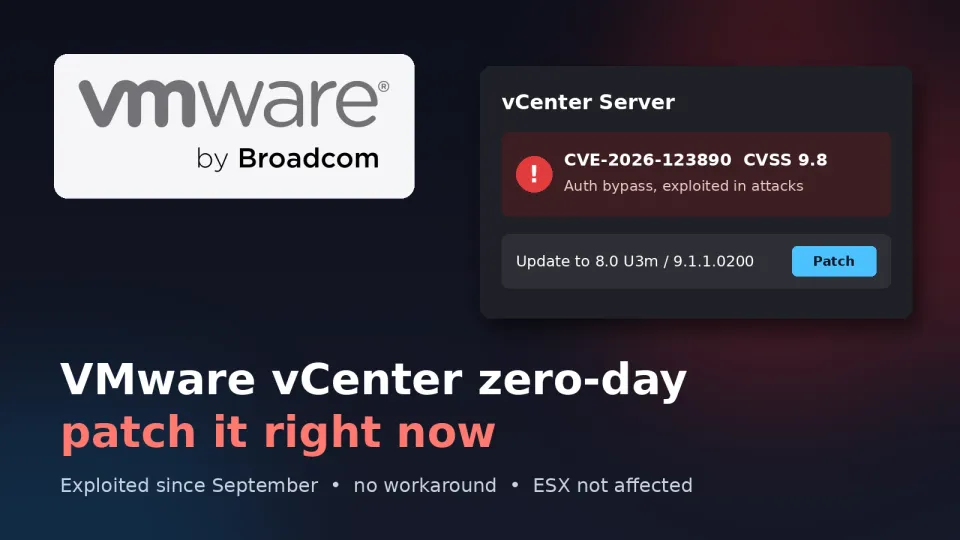
If you look after a VMware vCenter Server, at work or in a home lab, stop and check its version today. Broadcom shipped an emergency fix on Thursday, November 19 for an authentication bypass rated 9.8 out of 10, and Google's Mandiant says a Chinese state-linked group had been quietly using it since early September.
What happened
The bug, CVE-2026-123890, sits in the VMware Directory Service inside vCenter. Broadcom's advisory, VMSA-2026-0009, says anyone who can reach vCenter over the network can skip the login entirely and get in. There's no workaround. The only fix is the update.
The same day, Google Threat Intelligence Group and Mandiant published their findings. They track the attackers as ARMORY CASTLE (the group previously called UNC5221). The crew first broke into BeyondTrust Remote Support boxes through a separate zero-day, hopped onto an internal Linux appliance, then scanned for VMware ports. A custom Go tool called BONESAW hit vCenter's SSO control service on TCP port 2012, opened a session as administrator@vsphere.local, copied the directory database, pulled the SAML token-signing key and created a new SSO admin account. From there they turned on SSH, grabbed vCenter's master key and database password, logged into ESXi hosts as root, and lifted Active Directory files straight off virtual machine disks.
One detail stands out. Mandiant says BONESAW worked against a vCenter that was already patched for the July bypass, CVE-2026-59309. So if you patched in the summer, you still need this one. CISA added the flaw to its Known Exploited Vulnerabilities catalog on November 20. Broadcom itself hasn't confirmed exploitation, as BleepingComputer notes. The Hacker News flagged the advisory on X within hours.
Which versions fix it
| You run | Update to |
|---|---|
| vCenter 9.1.x (VCF / vSphere Foundation) | 9.1.1.0200 |
| vCenter 9.0.x | 9.0.2.0200 |
| vCenter 8.0 | 8.0 U3m |
| VMware Cloud Foundation 5.x | 5.2.5 (async patch, KB88287) |
| vCenter 7.0 | Only through a Broadcom extended support contract |
| VMware Tools for Windows 13.x / 12.x / 11.x | 13.1.5.0 or 12.5.5 |
The advisory also covers three SDDC Manager bugs and a privilege escalation in VMware Tools for Windows (CVE-2026-123894) that only matters inside guests set up with guest alias mapping. Broadcom's Q&A page says ESX hosts, Workstation and Fusion aren't affected, and that turning off Enhanced Linked Mode doesn't protect you.
Why it matters
vCenter is the keys to everything. Whoever controls it can start, stop, clone and read every virtual machine it manages. The stolen signing key makes this worse than a normal break-in: with it, attackers can forge login tokens that sail past MFA and pretend to be any user. Patching closes the door, but it doesn't kick out someone who already walked through it.
What to do
- Check your build. It's on the Summary tab in the vSphere Client. In PowerCLI, run
Connect-VIServer, then read$global:DefaultVIServer.Build. - Update vCenter. You can do it through the appliance management page (VAMI) or your normal lifecycle tooling. Broadcom says these builds aren't eligible for vCenter Quick Patch, so plan a short outage. Running VMs keep going while vCenter reboots.
- Lock down access. Port 2012, the web UI on 443, VAMI on 5480 and SSH should only answer your management machines. Mandiant also points to its VCSA Hardening & Logging Tool for firewall rules and syslog forwarding.
- Look for intruders. Review SSO users for accounts you didn't create. Mandiant saw one named
sps-followed by random characters. Also check for SSH being switched on and off unexpectedly. - Update VMware Tools inside Windows VMs to 13.1.5.0 or 12.5.5.
My take
Most people reading this blog don't run vCenter, and that's fine. But if you do, whether that's a few hosts at a small company or a lab you built off a guide, this is the one to handle before Monday. Nobody brute-forces a 9.8 auth bypass. Attackers just walk in, and this group has had a two-month head start.
The part I'd take most seriously is the clean-up, not the patch. If your vCenter was reachable from a machine that later turned out to be compromised, I'd treat the signing key as gone. That means renewing the STS certificate and changing the passwords for administrator@vsphere.local and the database, not just installing 8.0 U3m and moving on. If you're still on vCenter 7.0 without extended support, you have no patch at all, so it's time to firewall it hard and plan the move to 8 or 9.
This also fits a pattern I keep writing about: attackers go after the boring box in the middle that nobody watches. Last month it was the Cisco firewall VPN zero-day, and this week it was the NGINX2Root bugs. Management consoles belong on a separate network or behind a VPN, never open to the internet. For home labs, the safer route is often a hypervisor you can update in five minutes; my Proxmox vs Hyper-V vs VirtualBox comparison covers the trade-offs. More check-and-patch walkthroughs live in my security checks hub.

Comments ()