Google's AI Satellite Sends Its First Answer From Orbit
Google's Project Suncatcher satellite ran Gemma 4 on a TPU in orbit and beamed back a haiku. Radiation tests come next, and twin satellites in 2027.
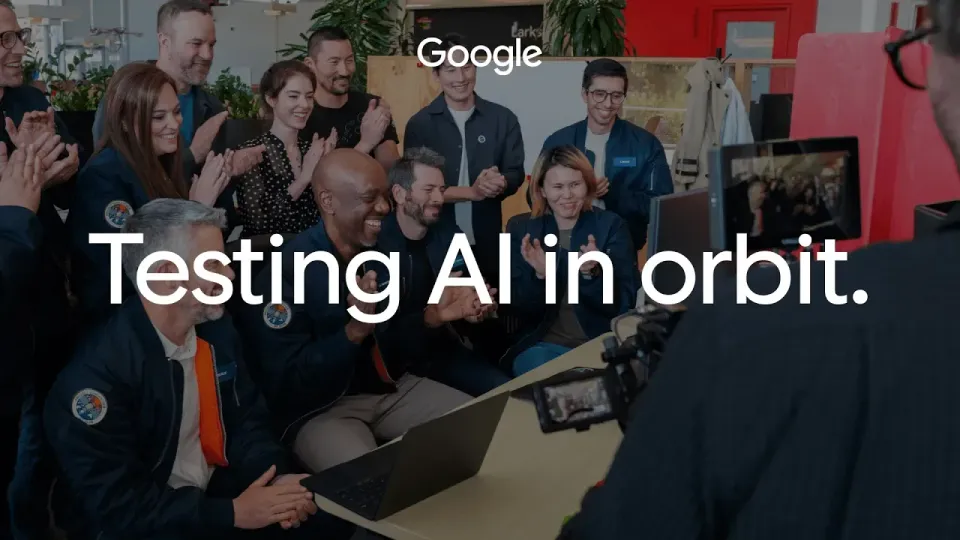
Google's satellite with AI chips on board has done its first real job in orbit, and it was writing a haiku. It sounds like a gimmick, but it's the first proof that Google's plan to put data center hardware in space can actually switch on and answer a prompt.
What happened
Google launched its Project Suncatcher prototype satellite on October 1. In a post on The Keyword on October 30, Travis Beals, who leads the project, said the team spent the following weeks on commissioning: powering up the host computer and the TPU trays (TPUs are Google's own AI chips) and running early machine learning tests.
This week, during a ground-station pass, the team uplinked a prompt to the open Gemma 4 model running on board and asked for a haiku about being in space. The reply came down as the satellite passed over Svalbard in Norway:
Blue marble below
Data streams in silent grace
Starlight feeds my core.
Sundar Pichai called it a "hello world" milestone on X. Google says it followed up with space-themed limericks and prompts asking the payload to report its own technical status.
According to TechCrunch, the satellite carries four TPUs and generates up to 1 kW of power, but it can only run one TPU at a time, for about 20 minutes, because of how much power the chip draws. The Verge also covered the transmission.
Why it matters
AI data centers on the ground are hitting real limits on electricity, land and cooling. Suncatcher is Google's long-shot bet that solar-powered satellites full of AI chips could eventually take on some of that work. Booting a data center class chip in orbit and getting a clean answer back is step one. The harder questions are still open.
The big one is radiation. Space radiation can flip bits in memory and quietly corrupt data. Google has tested its TPUs in particle accelerators, and TechCrunch says ground tests suggested inference (answering prompts) should cope better than training. Now Google gets to find out with real hardware in orbit. If those tests go well, the next milestone is a pair of interconnected satellites in 2027.
What to do
Nothing, really. You won't be sending your Gemini chats to orbit any time soon. But if you follow where AI computing is headed, this is one to watch, alongside Google's model work like Gemini 4 Carbon. The interesting update will be the radiation and heat results, which will tell us whether this stays a fun experiment or turns into something bigger.
And for the record, I've read worse haiku written by humans.

Comments ()